
This enquiry was never a single part: it was three part numbers at 1,000 pieces each, every month. That changes what has to be checked. On a prototype you can absorb a coating that lands two hundredths of a millimetre thick. On 3,000 pieces a month, that is a drawing revision — and on a 3 mm wall, it is also a manufacturing decision.
At a Glance
| Industry | Industrial equipment manufacturer in Turkey, buying through an independent sourcing partner |
|---|---|
| Parts | Three: a steel tube turned at both ends, an aluminium cap with an M27×1.5 thread, a milled aluminium block (140 × 80 × 75.6 mm) |
| Materials | Steel tube to the ST37 group, Ø50 × 3 mm wall · aluminium 6061/6082 for the cap · aluminium block, grade to be confirmed in writing |
| Input received | STEP 3D models for all three parts; 2D drawings for two of them only; general tolerances assumed to DIN 2768-m pending written confirmation |
| Quantities | 3,000 pcs per month — three part numbers × 1,000 pcs |
| Key requirements | Cap outer diameter held to ±0.02 mm, supplied as-machined with no treatment · steel tube galvanized as a separate operation |
| What we returned | Geometry review from the models, a blank specification for the tube (cold-drawn seamless Ø50 × 3, cut at 318 mm), both galvanizing routes set out with their dimensional consequences, and a written list of what still has to be confirmed |
| Trade terms | Unit price prepared with FOB and delivered options, coating quoted as its own operation |
The Customer
A Turkish sourcing partner buying for an industrial manufacturer in Turkey, working from 3D models rather than a released 2D drawing pack — the drawings exist for two of the three parts, and the third has none at all. What the end user wants is one supplier for the three-part set, a monthly call-off, and a price that holds across it.
The Challenge
- The enquiry is a production series, but not a complete drawing pack: 2D drawings for two part numbers, a 3D model only for the third, and two part numbers in the drawing sequence that were never supplied at all.
- The steel part is a tube, not a bar part: Ø50 with a 3 mm wall, 314 mm long, turned at both ends to two different diameters. Price it as a bar part and the number is wrong; be unable to buy the tube and the part cannot be made at any price.
- "Galvanized" arrived without a standard or a thickness — and the two routes behave nothing alike on a 3 mm wall. Hot-dip means molten zinc, coating on both faces, and the risk of bowing across 314 mm; electro-galvanizing adds a controlled layer that can be measured.
- The cap is an 118-face turned part: Ø50 down to steps at Ø26 and Ø5.20, an M27×1.5 thread, and an outer diameter held to ±0.02 mm — tighter than general tolerances by a wide margin.
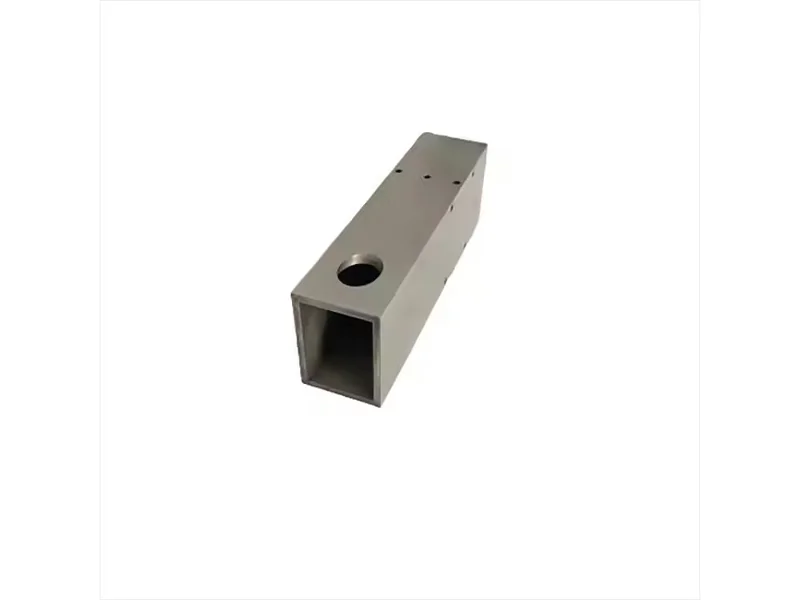
- The block is a 377-face milled part, 140 × 80 × 75.6 mm, with roughly half the material removed — the part of this set where cycle time, and therefore the monthly price, actually lives.
Our Approach
- Geometry read from the models, part by part. Tube: 140.6 cm³ ≈ 1.10 kg finished. Cap: 52.3 cm³ ≈ 0.14 kg from Ø50 bar, with 14 different diameters between Ø2 and Ø50. Block: 439.7 cm³ ≈ 1.19 kg, with about 48% of the blank machined away. Those three numbers decide cycle time, and cycle time decides the monthly price.
- The tube blank was specified, not assumed. Cold-drawn seamless Ø50 × 3 (bore 43.9–44.1 mm), material in the ST37 group, cut at 318 mm per piece — about 1.14 tonnes of tube for the first 1,000 pieces. Buying the tube is a separate supply question from machining it, and it is answered before the price.
- Both galvanizing routes set out with their numbers. Hot-dip on a 3 mm wall means coating both faces, a bowing risk over the 314 mm length, and zinc build-up at the ends that has to be machined off — which means pre-machining allowance and a finishing operation after coating. Electro-galvanizing applies 8–12 µm per face, so Ø49.70 grows 0.016–0.024 mm — inside DIN 2768-m, with no re-machining needed.
- Coating treated as a process, not as a finish. Galvanizing is an outsourced operation at a coating shop, so machining and coating are priced as two stages, exactly as any other special process would be.
- What still has to be confirmed was written down. The aluminium grade for the block, the coating standard for the tube, written confirmation that the general tolerance system is DIN 2768-m, and the two part numbers missing from the drawing sequence.
Where the Model Met the Shop
| What we had | What we did |
|---|---|
| STEP models for all three parts, 2D drawings for two | Geometry read from the models for all three, and the drawing set — including the part numbers missing from it — listed back before pricing |
| A Ø50 × 3 mm tube, 314 mm long, turned at both ends | Treated as a tube part rather than a bar part: blank specified as cold-drawn seamless Ø50 × 3 cut at 318 mm, roughly 1.14 t for the first 1,000 pieces |
| "Galvanized", with no standard and no thickness | Both routes laid out with their consequences: hot-dip needs pre-machining allowance and post-coating finishing at this wall thickness; electro-galvanizing's 0.016–0.024 mm growth stays inside DIN 2768-m |
| Cap outer diameter ±0.02 mm, as-machined, no treatment | Turned and gauged to the tighter of the two callouts, with any finish excluded from the price line rather than quietly assumed |
| M27 × 1.5 thread and 14 diameters from Ø2 to Ø50 | Priced as a threaded, stepped part — thread geometry included in the operation and checked with go/no-go gauges |
| 3,000 pcs per month across three part numbers | Priced per part against the monthly quantity, with coating as its own line and the blank material as its own question |
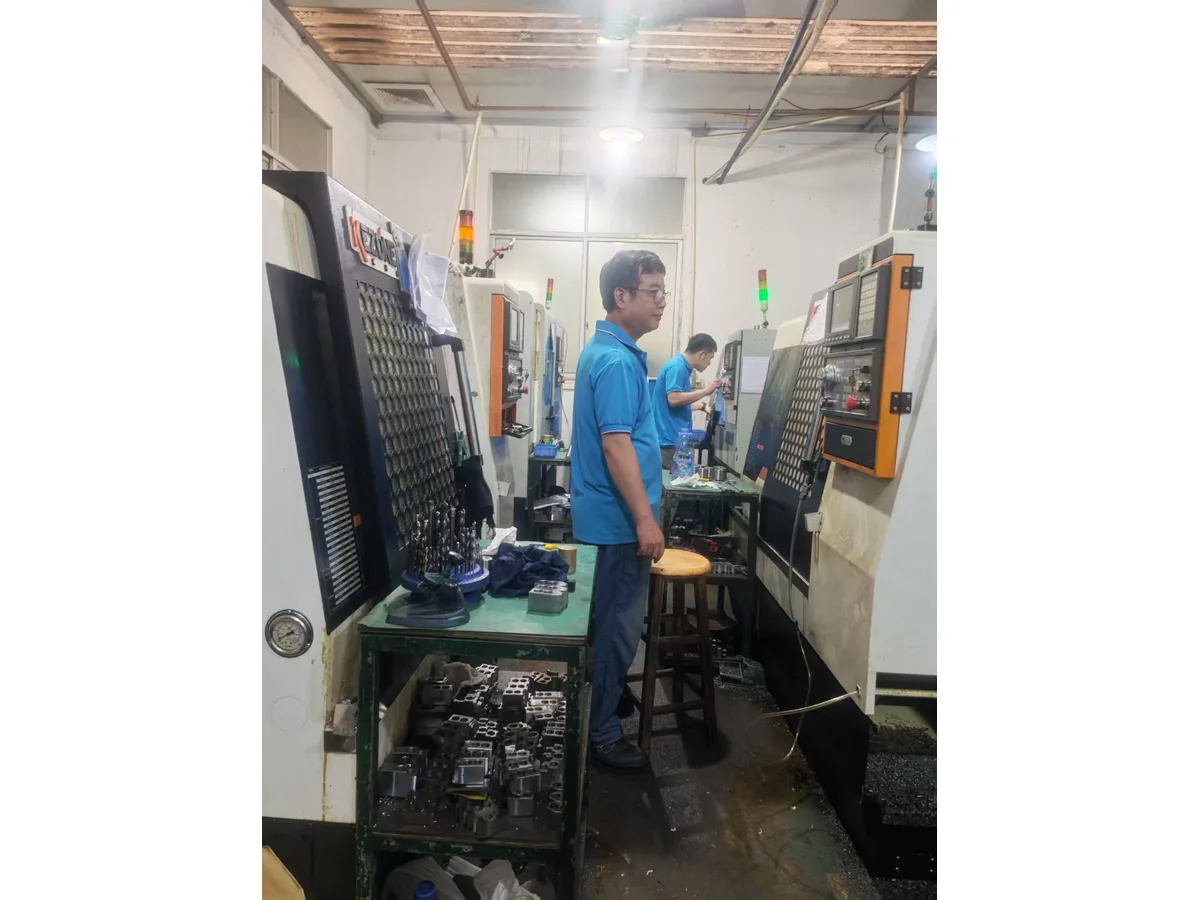
The purpose of the review was to get the blocking questions out of the way while a price still means something. A monthly series of 3,000 pieces cannot absorb a coating standard that changes after the first batch, or a tube that turns out not to be available in the specification everyone assumed.
What the Customer Received
| Geometry review from the models | Volume, finished weight and machined-away material for all three parts, taken from the STEP geometry |
|---|---|
| Blank specification | Cold-drawn seamless Ø50 × 3 tube, cut at 318 mm per piece — the tube question answered as a material question |
| Both galvanizing routes in writing | Coating thickness, the dimensional growth it causes, and what changes at 3 mm wall thickness |
| Questions instead of assumptions | Aluminium grade for the block, coating standard for the tube, written confirmation of the DIN 2768-m tolerance system, and the two missing part numbers |
| Models accepted for quoting | No demand for a complete 2D drawing pack before a price can be produced — the missing 2D drawing for the block is not a blocker |
| Trade terms | Unit price prepared with FOB and delivered options, and coating quoted as a separate operation |
Status
All three parts have been reviewed and costed on our side from the models supplied. What is still outstanding sits with the enquiry rather than with the machines: the aluminium grade for the block, the coating standard for the tube, written confirmation that the general tolerance system is DIN 2768-m, and the two part numbers missing from the drawing sequence.
Once those are in writing, the price per part can be fixed against the monthly volume — with the coating route already the one that fits the wall thickness, instead of a question that resurfaces after the first batch of 1,000.
Frequently Asked Questions
Can you price a monthly series from STEP models without a full 2D drawing pack?
Yes. All three parts here were reviewed and costed from the models. A missing 2D drawing for one part is not a blocker — we read the geometry, state the tolerance system we are working to (DIN 2768-m unless something else is confirmed) and list whatever a drawing would normally settle but the model cannot.
Which galvanizing should be specified for a turned steel tube?
It depends on the wall thickness, the length, and what the coating has to protect. On a 3 mm wall and a 314 mm length, hot-dip galvanizing coats both faces, carries a bowing risk in the bath, and builds zinc at the ends that has to be machined off — that means pre-machining allowance and a second turning operation after coating. Electro-galvanizing lays down 8–12 µm per face: Ø49.70 grows 0.016–0.024 mm, which stays inside DIN 2768-m and needs no re-machining. If the drawing does not name the standard, settle it before the first batch.
Does a coating change the dimensions of a machined part?
Yes, and always on the diameter in both directions: a coating lands on every face it reaches. Threads either get cut undersize/oversize by agreement or are gauged after coating, and any dimension measured after coating has to carry the layer thickness inside the tolerance stack. On a general tolerance of ±0.3 mm it is usually free; on a ±0.02 mm callout it is a different conversation.
Do you supply the material as well as the machining?
Yes, when it makes sense as one order. For the tube in this case the blank is cold-drawn seamless Ø50 × 3 cut at 318 mm per piece — specifying and buying that is part of the quotation, because a tube part that nobody can buy is not a part that can be produced.
Is there a minimum order quantity for a monthly series?
There is no minimum order quantity. A monthly call-off of 1,000 pieces per part number is normal work for us, and a smaller first batch to prove the process is possible too — quantity changes the unit price, not whether the work is taken on.